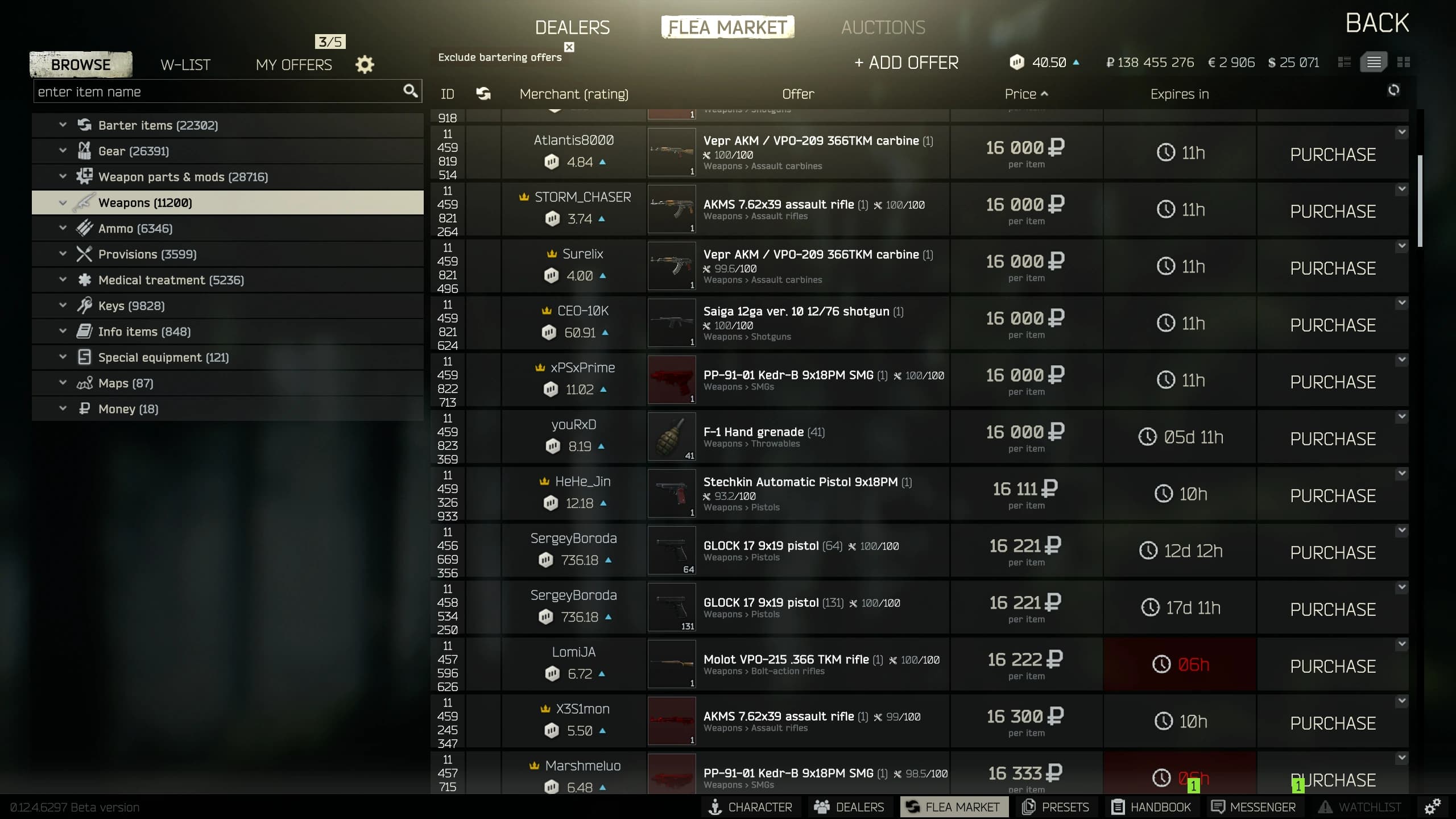
You list an item at what looks like a fair price. Ten minutes later someone lists the same item for a few roubles less, and your offer drops down the list where nobody sees it. That is the flea market working as designed: buyers sort by price, and the cheapest offer sells first.
Getting undercut is not a sign you did something wrong. It happens to everyone, all day, on every item that sells. The players who do well on the flea are not the ones who avoid being undercut. They are the ones who notice it fast and react before their offer sits dead for hours.
Why the cheapest offer wins
When a buyer searches for an item, the flea shows a list of offers, and most buyers sort that list by price. They look at the top few rows, pick the cheapest one that fits what they want, and move on. Very few people scroll down to find your offer if it sits below a dozen cheaper ones.
That means position on the list matters more than the exact price. An offer that is a few roubles cheaper than everything else gets nearly all the sales for that item until someone beats it. An offer that is a few roubles more expensive can sit untouched even when the market is busy.
It also means the market moves in small steps. Each seller shaves a little off the last lowest price, so prices drift down until they reach a level where people stop listing. Your job is to stay near the front of that line without giving away more money than you need to.
Price just under the lowest comparable offer
Look at the cheapest offers for the same item and price a little under them. You do not need to beat them by much. A small undercut puts you at the top of the list, and buyers rarely scroll past the first few offers.
Cutting deep does not sell the item any faster than cutting slightly. Once you are the cheapest offer, you are the cheapest offer. Every extra rouble you knock off past that point is money you hand to the buyer for nothing.
Skip offers that are not a fair comparison: items in worse condition, barter offers that ask for items instead of money, and offers priced in dollars or euros. Pricing against those can leave you far too low.
Condition matters most on gear like armor, weapons and some meds, where the flea lists items with different durability or uses left. A half-broken helmet listed cheap is not your competition if yours is barely worn. Compare against offers in roughly the same condition as yours, and filter the list if the game lets you.
When you create an offer, Tarkov also shows a suggested price for the item. It follows the market, so it is a sensible starting point when you are not sure. Check it against the live list anyway, since the cheapest offers can move faster than the suggestion.
A worked example
Here is how it plays out with made-up round numbers. Say you have a barter item to sell, and the three cheapest rouble offers for it are 30,000, 30,500 and 31,000. Below those there is a barter offer asking for two other items, and an offer in dollars. You ignore those two.
You list at 29,900. You are now first on the list, a hundred roubles under the next seller. You did not need to list at 27,000 to sell faster. At 29,900 you are already the cheapest, and the extra 2,900 stays in your pocket.
An hour later you check your offers and yours has not sold. You search the item again and see someone listed at 29,500. Your offer is now second. If that item sells steadily, you cancel, list again at around 29,400, and pay the listing fee a second time. If the fee on a second listing would eat most of the gap, you may be better off waiting or taking a trader price instead.
Pull listings that have not sold
This is the step most players skip. Once a cheaper offer appears, your listing is unlikely to sell at its price, but it still takes up one of your limited offer slots. Cancel it, check the new lowest price, and list again.
Offer slots are the real limit on how much you can sell. You can only have a certain number of offers up at once, and that number grows as your flea rating goes up. A slot holding an offer nobody will buy is a slot you are not using to sell something else.
A simple habit helps here. Each time you come back from a raid, open your offers and look at what is still listed. For anything that has been up a while, search it and see where it sits. If it has been pushed down the list, decide right then whether to relist, wait or give up on it.
Mind the listing fee
You pay a fee every time you place an offer, and it is not refunded when you cancel. Relisting a cheap item over and over can eat the whole profit, so the fee is the reason you cannot just relist every time someone beats you by one rouble.
The fee is shown on the offer screen before you confirm, so read it each time. It tends to climb when you ask a lot more than what the game thinks the item is worth, which is another reason not to overprice and then sit there waiting.
For low-value items, a trader may be the better buyer. If the flea only pays a little more than a trader after the fee, and you might have to relist once or twice, the trader's fixed price with no fee and no wait is often the smarter sale.
Sell what moves
Items people buy all the time, like popular barter items, ammo and meds, sell quickly with a small undercut. Your offer often sells within minutes of reaching the top of the list, before anyone gets the chance to beat it.
Rare items sell slower, so give them more time before you decide the price is wrong. A rare item might only have a handful of buyers looking for it each hour. Being undercut on one of those does not always mean your offer will never sell, since the cheaper offer may sell first and then yours is back at the top.
Some items cannot be listed on the flea at all, and only items that count as found in raid can be listed. Found in raid means the game has marked the item as something you brought out of a raid yourself (or got from a source the game treats the same way, like the scav case). Items you bought from a trader or another player usually lose that mark, so check before you plan to resell something.
Early wipe and late wipe
A wipe is when the game resets every player's progress, usually once or twice a year. The flea behaves very differently at the start of a wipe compared to months into it.
Early in a wipe, many players are short on money and chasing the same quest items and hideout materials. Demand for those items is high, prices are high, and they can sell fast even without a big undercut. Prices also swing hard from hour to hour, so check the list right before you price anything.
Later in a wipe, more players have finished the common quests and built most of their hideout. Demand for many of those items falls, more sellers compete, and prices drift down. Undercutting gets tighter, offers get beaten faster, and it pays to check your listings more often.
Common mistakes
Undercutting by far too much. Beating the lowest offer by a large margin does not sell the item any faster than beating it by a little. It only leaves money on the table.
Pricing against the wrong offers. Barter offers, dollar and euro offers, and items in worse condition all make the market look cheaper than it is. Compare like with like.
Listing and forgetting. An offer that has been beaten can sit in a slot for a long time doing nothing. Check your offers between raids.
Relisting cheap items too often. Each relist costs a fee you never get back. On a cheap item, two or three relists can turn a profit into a loss.
Selling everything on the flea out of habit. Some items pay almost the same at a trader, and the trader pays at once with no fee and no slot used.
A quick checklist
Before you list: search the item, sort by price, and find the cheapest offer that is a fair comparison. Glance at the suggested price on the offer screen.
When you list: price a little under that offer, not a lot under it. Read the fee before you confirm, and make sure the sale is still worth it after the fee.
After each raid: open your offers. For anything still unsold, search it again. If it has been beaten, relist it, wait if it is a slow item, or sell it to a trader if the fee would eat the gap.
Quick questions
How much should I undercut by? Enough to be the cheapest fair offer, and no more. On most items a small amount does the job.
Should I always relist when I get undercut? No. Relist when the item sells often enough that you will sell soon at the new price, and the fee is small next to the price. For slow or cheap items, waiting or using a trader is often better.
Why did my offer not sell even though it was the cheapest? Someone may have listed lower in the meantime, the item may simply not have many buyers right now, or buyers may be filtering for something your item does not match, like condition. Search it again to see where it sits.
Is the suggested price always right? It is a good starting point, but it can lag behind the live list. Treat it as a guide and check the actual cheapest offers before you settle on a number.
Checking and relisting every offer between raids is repetitive, which is why some players hand it to a tool like Tarkbot. Whether you do it by hand or not, the method stays the same: price just under the lowest fair offer, then keep your slots full of offers that can still sell.